
We engineer the structure, procure and fill every door, and ship finished calendars to your distribution center or retailer from campuses in North America and Europe.
Page last updated: November 13th 2026

Custom advent calendar boxes are branded countdown packs with 12 or 24 numbered doors or drawers, each holding a product revealed one day at a time. A box printer supplies the empty structure.
A co-packer like Truvant also engineers the inserts, procures the contents, fills every door in the right order, checks each finished calendar and packs it for retail or ecommerce.
We run that work as part of our contract packaging services, on the same lines that pack your product. You hand over one brief and get finished calendars back, instead of coordinating a printer, an insert maker, a filler and a warehouse through the busiest quarter of the year.
Advent calendar packaging formats we build
Book or gatefold
Best for: Mass retail and ecommerce, 24 doors
What to plan for: Ships flat and packs dense on a pallet; perforated doors need a tested tear strength
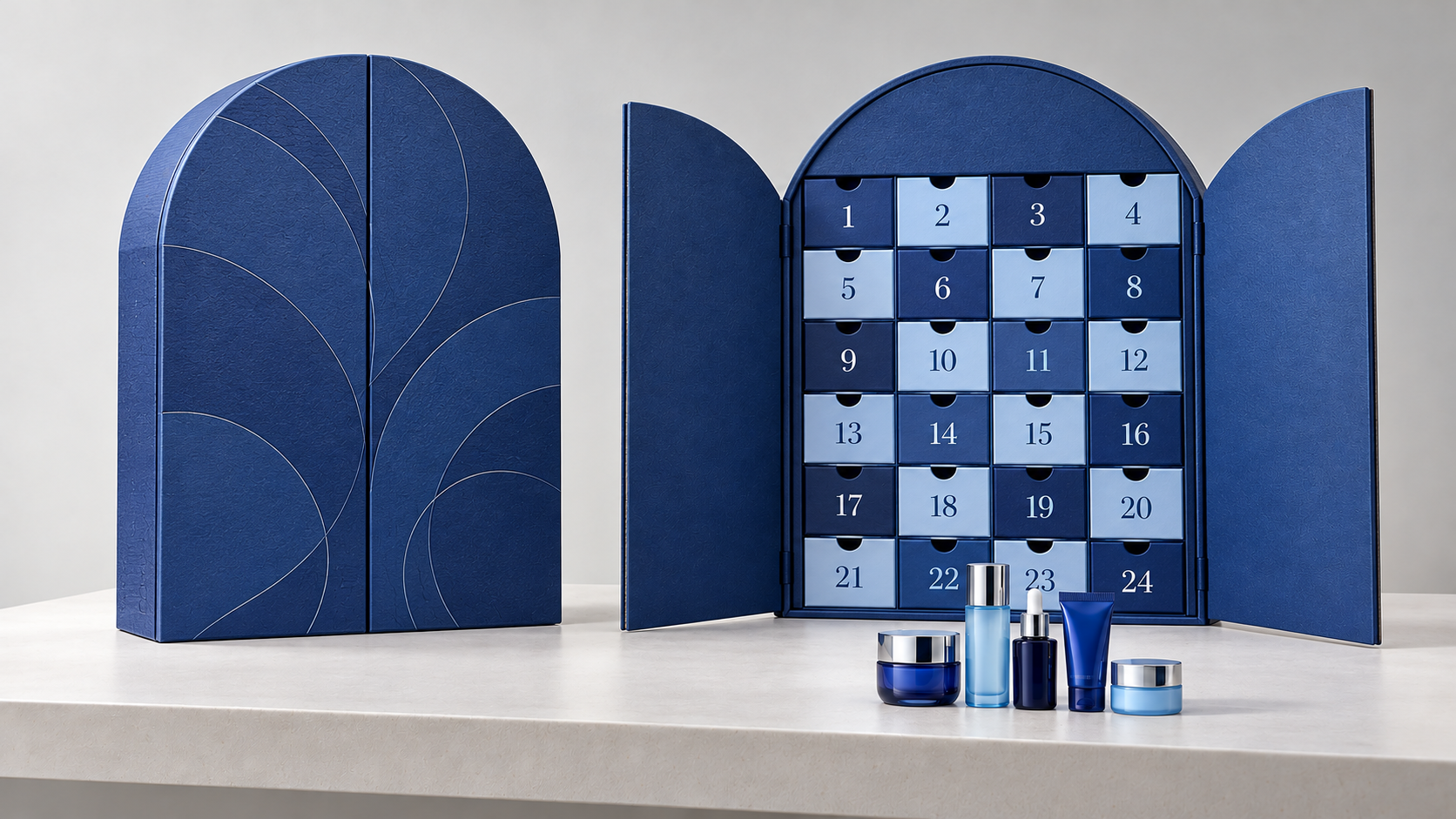
Drawer tower
Best for: Prestige beauty and fragrance
What to plan for: More hand assembly per unit; ribbon pulls add non-fiber material
Tray and sleeve or lift-off lid
Best for: 12-day calendars, larger items
What to plan for: Fewer parts and faster to fill; less door-by-door drama
Layered reveal
Best for: Weekly or themed openings
What to plan for: Fewer components, more die lines and print plates
Shaped (tree, carousel, house)
Best for: Statement retail displays
What to plan for: Highest shelf impact, wasted case-pack space, complex glue lines
Keepsake box
Best for: Premium sets meant to be reused
What to plan for: Highest unit cost, justified by a second life on the shelf at home
The insert decides more than the outer box does. It holds each item in place, protects glass in transit and sets how fast a line can fill the calendar. We engineer fiber inserts from folded board or molded pulp first, and use thermoformed trays when the product needs it, such as heavy glass or irregular shapes.
Search for an advent calendar manufacturer and most of the results sell empty boxes. That works for a small run you fill yourself. It breaks down at retail volume, when 24 different products from a dozen suppliers have to land in the right doors, by a fixed date, with every unit checked.
Truvant is a contract packager. We build the finished calendar, not the contents: your products, minis or confectionery arrive at our campus, and the complete calendar leaves it. As your advent calendar supplier for the whole program, we cover every stage.
Structure, inserts and components
Our packaging engineers size the box and insert around your real items and test samples before artwork is final. We buy printed cartons, inserts and shippers, and can procure contents or missing materials through our supplier network.
Filling and assembly
Trained crews fill each door against a door map, close and seal the calendar, and add sleeves, ribbons or gift-with-purchase items. It is the same discipline as our kitting and assembly services.
Quality and traceability
First-article approval, in-line checks and lot and date codes recorded for every component, so a recall or retailer query can be traced to the door.
Packout and shipping
Retail-ready cases and pallets to your distribution centers, or ecommerce-ready units through our ecommerce fulfillment team.
The expensive changes are the ones made after artwork is approved. We settle these questions with your team before anything goes to print.
The largest item sets the grid. Every door is sized from physical samples of the real products, not from spec sheets.
Glass and ecommerce: fragile items and parcel shipping drive the flute grade, the insert design and drop testing. We prototype the insert before the outerbox.
Ships flat or arrives set up: a book ships flat and fills fast. A tower or shaped design costs more in freight and case-pack space, so we quote both together.
Retailer and channel: shelf dimensions, case counts and labeling rules come from the retailer early, not at first shipment.
Sustainability claims: plastic-free or curbside-recyclable claims rule out some materials and finishes, so we agree on the claim before choosing the material.
Two concepts, then one: we take no more than two concepts into sampling, then lock structure, opening mechanic and contents together. Changes after that go through a priced change request.
A sustainable advent calendar starts with the insert. Swapping a thermoformed tray for folded board or molded pulp often removes most of the plastic in the pack, and makes a plastic free advent calendar possible without losing protection. Ribbons, foils, magnets and windows are where recyclability claims usually fail, so we flag each one during design.
Paper-first design is how we work across programs. Paper makes up 86% of the packaging materials used at our European campuses, and redesign work with customers has removed 475 tonnes of plastic, mostly by moving blister packs to paper flowpacks. When plastic is needed, we can run recycled content: one nail care brand moved its film from 12% to almost 100% rPET at an 80% post-consumer spec in under a year.
More on our sustainable packaging work.
Each category brings its own handling rules.
We plan the line, the checks and the paperwork around what goes behind the doors.
Beauty and personal care: 12- and 24-day calendars of minis, full sizes and fragrance, where presentation is judged at the shelf. Our European campuses run holiday programs for global beauty houses.
Toys and collectibles: collectible figures and play sets with a final-day hero item, built for mass retail and club stores. See our consumer products work.
Confectionery and food: chocolate, candy and snack calendars, packed under BRCGS AA+, FDA and USDA standards. We pack food; we do not manufacture it.
Household and home fragrance: candle, wax melt and home care calendars, where weight and fragility shape the insert.
Branded and corporate programs: a branded advent calendar as a retailer exclusive, a promotional advent calendar for gift-with-purchase, or a corporate advent calendar for clients and staff, built to the same standard as a launch product.
An advent calendar is a hard pack to build: up to 24 products, several suppliers, hand-placed items and a launch date that cannot move. It needs a packer that can add trained people fast and keep quality steady while it does.


We fill advent calendars close to where they sell. North American programs run from Texas and Wisconsin, near US distribution centers. European programs run from our campuses in central Europe, where language variants and EU labeling are handled under the same quality system.
Texas, US
Campus: Haslet (Dallas-Fort Worth)
Advent calendar work: High-volume seasonal programs for North American retail
Wisconsin, US
Campuses: Prairie du Chien, Boscobel
Advent calendar work: Food-grade and consumer goods packing, display builds
Poland, EU
Campuses: Stryków, Łódź, Wrocław
Advent calendar work: Beauty holiday programs and EU retail, with a bonded warehouse at Stryków
Every door holds a product that has to reach the shopper as clean and intact as it left your supplier. The standards behind the line matter as much as the box.
Certifications vary by campus. See why brands choose Truvant.
BRCGS AA+
with zero non-conformities
in our 2024 audit
FDA, USDA
and cGMP
standards at our US campuses
Sedex
member
SMETA
audited
EcoVadis Silver 2026
for Truvant Europe
Custom advent calendar boxes are branded countdown packs with 12 or 24 numbered doors or drawers, each holding one product. Brands use them for holiday launches and gifting. A printer supplies the empty box; a co-packer such as Truvant also engineers the inserts, fills every door, checks each calendar and ships it ready for retail or ecommerce.
For a 24-door calendar with contents from several suppliers, brief your co-packer 10 to 12 months before launch. Lock the structure and contents about eight months out, receive components over the summer, and fill from July to September so calendars reach retailers in October. Simpler 12-day formats with stock components can run on a shorter timeline.
Truvant builds and fills finished advent calendars as a contract packager. We engineer the box and inserts, procure the printed components, fill every door with your products, check and seal each calendar, and ship it. We do not make the contents: your cosmetics, toys or confectionery come from you or your suppliers, and we pack them.
No. Truvant runs complete advent calendar programs, where we engineer or procure the box and fill it. If you need a small run of empty boxes to fill yourself, a box printer is the better fit. If you need thousands of filled calendars delivered to retailers on a fixed date, that is the work we do.
Cost depends on the number of doors, the structure, the insert material, print finishes such as foil or embossing, the number of different products and the hand touches per unit. Run length matters too: long runs of a simple book format cost less per unit than short runs of a drawer tower. Send us your brief and volumes for a quote.
Almost anything that fits a door: cosmetic minis and full sizes, fragrance, nail polish, collectible toys, chocolate and candy, candles and small home goods. Each product type sets its own rules for the insert, the handling on the line and the checks we run, so we plan the calendar around the contents first.
Yes. We pack confectionery and food calendars to FDA and USDA standards and hold BRCGS AA+, with zero non-conformities in our 2024 audit. We pack food; we do not manufacture it. Tell us the products and their storage needs, such as temperature limits for chocolate, and we will plan the line and the campus around them.
Start with the insert. Folded board or molded pulp can replace a thermoformed plastic tray in most calendars. Then cut back non-fiber extras such as magnets and ribbons, and agree the recyclability claim before choosing finishes. Where plastic is needed, recycled content such as rPET can replace virgin material.
Every calendar is filled against a door map approved by the brand. We run a first-article check before volume starts, check units in line during the run, and record lot and date codes for each component. That way, a retailer query or a recall can be traced back to the calendar and the door.
Minimums depend on the format and how the calendar is filled. Hand-filled programs can start at lower volumes than semi-automated ones, and stock structures need fewer units to make sense than fully custom builds. Share your expected volume and launch date, and we will tell you which approach fits.