
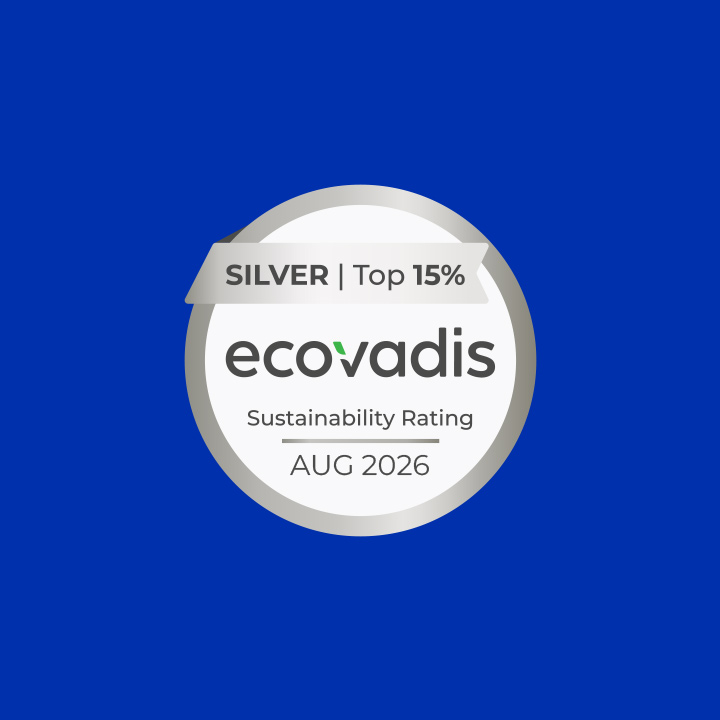
In August 2026, EcoVadis awarded Truvant Europe a Silver Medal with an overall score of 79 out of 100, placing us in the 92nd percentile of companies assessed by the platform over the previous twelve months. One year earlier, our score was 57.
Author
Maja Urban
Published
September 1, 2026
The improvement is significant, but the number alone tells only part of the story. What matters is what the assessment measures, why it matters to our customers, and what changed across our business to achieve it.
EcoVadis is the sustainability rating platform used by many of the world's largest consumer goods companies to evaluate suppliers. It assesses performance across four themes: environment, labor and human rights, ethics, and sustainable procurement. These areas are broken down into 21 criteria aligned with internationally recognized frameworks, including the UN Global Compact, ILO conventions, the GRI Standards, and ISO 26000.
The assessment is tailored to each company's industry, size, and geography. A packaging manufacturer in Poland is evaluated differently from a software company in California because the sustainability risks and impacts are fundamentally different.
What makes EcoVadis rigorous is its evidence-based approach. Every response must be supported by documentation that is reviewed by analysts. The platform also conducts its own review of publicly available information related to company operations. Policies alone carry limited weight. Greater emphasis is placed on actions implemented, management systems established, and measurable results reported.
For many brands, sustainability assessments have become a business requirement rather than a reputational exercise.
First, disclosure regulations increasingly require organizations to report emissions across their value chains, not just within their own operations. Packaging is part of that value chain. Our emissions contribute to customers' Scope 3 inventories, and reliable reporting depends on reliable supplier data. Truvant's carbon footprint across Scopes 1, 2, and 3 is calculated according to the GHG Protocol and independently assured to ISO 14064-3, enabling customers to use actual emissions data rather than estimates.
Second, many procurement organizations now establish minimum sustainability thresholds for suppliers. An EcoVadis rating is increasingly used as part of supplier qualification and risk management processes.
Third, it improves efficiency for both parties. A current, independently verified rating provides customers with a recognized source of sustainability information, reducing the need for duplicate questionnaires, site audits, and supporting documentation requests.
A sustainability program should deliver tangible outcomes, not just reporting metrics. In packaging, impact is measured by what changes in the product itself.
Packaging materials represent the largest source of emissions in our value chain, which is why much of our effort is focused there. In Europe, paper now accounts for 86% of the packaging materials we use, up from 82% in 2022. Recycled content represents 79% of all material usage. Over the same period, total packaging tonnage declined from 27,745 tonnes to 22,987 tonnes, reflecting an absolute reduction in material consumption.
Our packaging engineers work directly with customers to identify opportunities for improvement. Recent projects have included reducing leaflet page counts, eliminating 18 tonnes of paper while reducing leaflet weight by 24%, and optimizing carton dimensions to reduce material use while improving pallet utilization by 20% to 40%. We have also removed plastic windows from packaging formats where alternatives were feasible.
In another example, moving a customer's leaflet supply from Germany to Poland reduced transport-related emissions by more than 2,000 kg of CO₂e through shorter transportation distances alone.
We have also addressed more technically challenging materials. For one prestige beauty brand, we increased recycled content in blister packaging from 12% to nearly 100% by introducing PET film containing 80% post-consumer recycled content. Achieving that transition within a single year required overcoming both sourcing and manufacturing challenges, as high-PCR film performs differently from virgin material during forming and production.
These are the types of changes customers can incorporate into their own sustainability reporting because they affect the products they bring to market.
The improvement in our EcoVadis score reflects work that was already underway across the business.
We established and published 2030 sustainability goals, including commitments related to greenhouse gas reduction and renewable energy.
We joined the Sustainable Packaging Coalition, aligning our efforts with an industry-specific initiative and broader packaging sustainability best practices.
We strengthened sustainability governance within procurement. Every supplier under our management has been assessed for ESG risk, 99% of our full-service suppliers have signed our Code of Conduct, and supplier audits now incorporate environmental, social, and ethical considerations alongside traditional quality requirements.
We published quantitative performance targets covering energy, waste management, and workforce-related measures through our 2025 Sustainability Report.
We also completed a formal corruption risk assessment and strengthened our business ethics documentation and control framework.
A significant factor behind the improvement was the expansion of sustainability reporting to cover both European and North American operations. For the first time, both regions were measured through a common framework, a unified carbon inventory, and a shared set of goals, providing a more complete view of our performance.
It is important to note that the assessment itself was conducted for Truvant Europe. However, the supporting evidence came from our group-wide sustainability reporting, making this a result shaped by contributions from colleagues across the broader organization.
Publishing goals also means being transparent about areas where progress remains necessary.
Our employee engagement score and workplace incident rate remain below the 2030 targets we have established. While our European operations send no waste to landfill and direct 82% of waste to recycling, our North American facilities are at an earlier stage of their sustainability journey. In fact, 2025 was the first year we established a comprehensive environmental baseline for those operations.
Closing these gaps will require sustained operational improvements over multiple years.
No sustainability team can improve a rating of this scale on its own.
The progress reflected in our assessment was driven by teams across procurement, quality, HR, operations, packaging development, and finance in both Poland and the United States. Sustainability performance improves when it becomes part of how a business operates day to day, not when it sits within a single department.
Our EcoVadis rating remains valid through August 2027, and we are already reviewing this year's assessment results to identify opportunities for further improvement. We are evaluating additional certifications, expanding supplier audit coverage, and continuing to strengthen our sustainability management systems.
An EcoVadis score represents a snapshot in time. The more important measure is whether the underlying work continues to create value for our customers, our employees, and the wider communities in which we operate.
You can view our current EcoVadis recognition here: Truvant EcoVadis Recognition.
Maja Urban
Sustainability Manager

Maja Urban is Sustainability Manager at Truvant Europe, bringing her years of finance expertise in controlling, audit, and accounting across multinational organizations. ACCA certified, she directs the company's ESG program and sustainability reporting across operations in Poland and the U.S., combining her analytical rigor with leadership experience to drive measurable progress toward corporate and operational sustainability goals.